Paula at Horsekeeping Saved to Native American Hair Accessories Artdrawings
Native American Jewelry Tips
About Navajo, Hopi, Zuni, Santo Domingo, Apache and Oglala Lakota Jewelry and Artifacts on horsekeeping.com

What is repousse?
A method of embossing metal past stamping and hammering a design from the back to produce a three-dimensional bas-relief surface on the front.

Here is an excerpt from Indian Jewelry Making past Oscar T. Branson that shows the procedure.


Below are some examples of the repousse technique used by Native American jewelers.
One of the most archetype uses of the repousse techniques is on ketohs (bowguards).
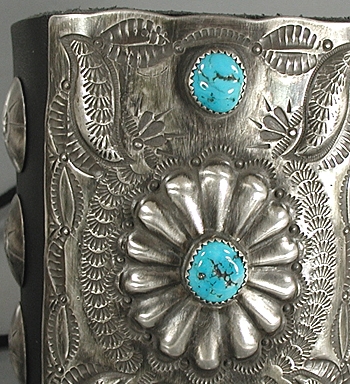
Ketoh (bowguard) past Navajo artist Daniel Martinez
View the slide show for other uses of repousse on ketohs. (Read more about ketohs on my previous post.)
Sterling Silver Repousse Buckle by Floyd Arviso


Sterling Silverish Repousse Cross by Robert Joe, Navajo
Orange Spiny Oyster and Satin Terminate Sterling bumble bee pin by Tim Yazzie


A vintage NOS (New Old Stock) pivot marked AP Sterling


The technique was used by Bell Trader's craftsmen in the Fred Harvey era such as this copper gage bracelet.
Read more about the Fred Harvey era in my previous mail.


View the slide bear witness beneath to see examples of Navajo barrettes that characteristic repousse designs.
Paula
Recently we received this beautiful pair of vintage pilus combs in an manor lot that were made past a Navajo silversmith at Woodard'south Indian Shop


[Marion (M.Fifty.) Woodard worked for the United Indian Traders Association (UITA) in the 1930s and also operated shops in Tucson, Scottsdale, Santa Fe and Gallup. Some of the noted artists that worked for Woodard's include Navajo silversmiths Kee Joe Benally, Wilson Tsosie, Joe D. Yazzie, and Willie Yazzie Sr. – from Native American and Southwestern Silvery Hallmarks by Bille Hougart:]

Probably from the 1950s. I found a very interesting oral history that I thought you might like to read. Information technology was posted on http://library.nau.edu/
This is Karen Underhill with Northern Arizona University. It is Monday, December 14, 1998, and we're hither with Tom Woodard for an interview about his life and association with Indian traders over the years. Also in the room are Brad Cole and Lew Steiger.
Underhill: And who were your parents?
Woodard: Thou. 50. Woodard and Ann Woodard. My dad, I estimate, got to Gallup about in the mid to late twenties. When he get-go was over there, he had a newspaper chosen Southwest Tourist News. And so, I think, in the early on thirties, 1930 on, he went to piece of work for the Chamber of Commerce and the Ceremonial Association and the United Indian Traders Association and the Highway 66 Association. He was in those jobs, I believe, until–I retrieve some of them he left near 1948. So I retrieve he resigned equally director of the Traders in 1950. I have a re-create of his resignation for the dates. I know they tried to get him to stay on, just he had opened a store in that location in Gallup at the same fourth dimension, so he was but too busy to handle all of it.
Underhill: What sort of store did he open?
Woodard: Indian craft. Of course he had worked forth with the traders for many, many years, but was never actually in the trading business himself, until he opened that store in the tardily forties. He did run the–during the war the Indian Traders Association got silver released to the Navajo people, because the older Navajos were of no use to the military in any style, because of their linguistic communication barrier…. Then in social club for them to brand a living, the traders got the silver released, and it was the but precious metal released during wartime for jewelry product. And information technology really created a boom menstruum for many of the silversmiths who were left hither in the area, and older people. That was a catamenia when some of the–I heard that Marshall Fields came out, sent a buyer out from Chicago, had a check for $50,000, and he just wanted sterling silver. And this was the only place that anyone could get it. Of course that was a lot of money in those days–not that it's not today, but it was a lot more then. It really did not help the quality of the arts and crafts in that they wanted something made out of a precious metal, they did not care what information technology looked like. Virtually of the traders were used to an entirely unlike blazon of jewelry–in that location was more work went into it, and a sense of blueprint and creativity and that was very of import, where at that point in fourth dimension it actually wasn't.
My dad actually ran that identify, and so he had a fellah that helped him. After the war, the traders did not encounter any reason to proceed in the silver business, because so many other people could get in it, and they sold the silver business that they had. And at that time, I think my dad had 'em put the money they got from that, in AT&T stock. And that's why we're all sitting here today! (laughter)
Underhill: Well, if we could dorsum up just a petty: why and when was the United Indian Traders Clan founded? Your dad went to piece of work as executive director.
Woodard: Before I was hither! (laughs) It was founded in the early thirties, and it is my understanding, and of course I probably ran over nearly of these early on traders with my tricycle or something like that. I got to know a number of them before I was really thoroughly interested in the Indian field. I mean, I just grew upwardly in Gallup and had a lot of very good Indian friends, just as far every bit the trading business, I didn't really fifty-fifty think a whole lot about information technology.
Only it is my understanding that the reason for the Traders Clan had a lot to do with regime controls and government interference. In the earlier days you had the BIA–Bureau of Indian Affairs–and some of these various Washington people that needed a Southwest vacation, I gauge, and they came out to "salve the Indians" and the traders were takin' advantage of 'em–which is not a true story at all. Fourth dimension afterwards time, they [the traders] had to prove that they were actually taking care of these people….
In that commodity I gave y'all that Tom Kirk did, just a minute agone, he discusses ane situation there where the traders would pay fifty cents an ounce for argent, and they would pay the Indian fifty cents an ounce to make it upward. Then they would sell it for a dollar an ounce. Well, where'due south their turn a profit? Well, they decided that their profit was in their trade, because the Indians traded the fifty cents labor deal there for groceries and things of that nature, or perchance interest on pawn or something like that. The turn a profit was built in elsewhere.
Now today, y'all make turn a profit on each i of 'em. (chuckles) The whole bookkeeping system was considerably different in those days.
***
Underhill: And if you lot had to generalize, what characteristics practise traders have in common?
Woodard: Well, when you go to, like, Harry and Mike Goulding, up in Monument Valley, which is really very remote and abroad from everything–not and then much today as it was then–only it was I call back at to the lowest degree a week-long trip from anywhere where there was any other type of civilization, and they would become out at that place past railroad vehicle. They would have to freight in everything that they traded with the Indians. And of form they moved out there as a young married couple, and they died out there. And no way would they leave. They had sold, or I believe they gave the property to a church back due east, which the church building sold to some individuals subsequently, and Mrs.Goulding moved back out there and finally passed abroad there. Merely most of them take pretty much gotten to actually like that life, and you're with people of an entirely dissimilar culture, and a very interesting people. Their values are then much dissimilar than you lot see with a lot of other people. But most of these early people just loved what they were doing, and they wouldn't leave it for anything, and many of them only died in that location where they had worked. And many of them, who, say, worked for traders, people who worked as employees for the people who endemic the postal service, they would go from post to post and piece of work as they would change easily and and then forth, would go to different places.
But what does a shoe salesman talk about when he gets home from work? I tin can tell yous that we all talk about trading, even after we go off work. And nosotros've done it many a fourth dimension 'til the wee hours of the morn. Just some of the stories, it's really different, it's a frontier-blazon life. I think that you have to say that many of these earlier traders were actually pioneers of the West, more than they get credit for.
***
It's non a story–well, this would be a true story. I appraised Mrs. Goulding'due south estate, and I was like a kid in a processed store, considering she had kept invitee books for many of the years that they were out there. There were quite a number of movies, and hither a few years dorsum, there wasn't one of those peaks at Monument Valley that didn't accept a brand new car on it. Now there's no style you could get the motorcar on. A piffling trick photography at that place. Only the people who have been in that remote expanse–which is still not on any browbeaten path–but the names of the people who have been at that place, the artists, the movie stars, the politicians–like Teddy Roosevelt was very well-known by a number of the traders out in this area. When you become into some of the history there, you lot get into a lot more than of those stories.
I met a fellah who was quite well-known, years ago at a funeral. I have thought very highly of the individual and have had contact with him since that appointment. His name was Johnny Cash. He appeared at a funeral of a young Navajo girl who was killed in a motorcar accident. Her married man was an creative person and he was in art schoolhouse back in Chicago and they went to a concert–the Indian people all like western music–and while sitting there, he did kind of a pencil sketch of Johnny Greenbacks, and they knew at that place was no way you could go to him after the concert, and so his wife took the sketch and gave information technology to ane of the security people dorsum there and said, "Just give this to Mr. Greenbacks. Nosotros're not tryin' to get in and see him or anything." Only she had written their telephone number and address on in that location. A couple of days later they got a phone call from Johnny Greenbacks. Information technology resulted in Johnny Cash bought a lot of his paintings, and used a couple of his paintings for album covers. And this happened to exist at Crownpoint, which yous just don't wait to see someone of that….
But he came to that funeral as a mourner and as a very sincere person. It really, really impressed me a slap-up deal.
***
I think I'd rather do business with Indian people than with Anglo people anytime. They really report what they want. And of course we were in the jewelry and rug business, and pottery and that type of thing. Merely just like when you need a plumber, not everybody's a plumber. And then y'all call a plumber. Well, not every Indian is a silversmith, then they go to a jewelry store and purchase their textile, or the things that they'd like.
We did handle some religious items. The peyote faith got to be very major among the people out here. Information technology had been very popular in Oklahoma, and that's the Native Church building of Due north America, which is an incorporated church. And it really defenseless on with the Navajos. It simply mushroomed over in that location. Many of the people who were in that religion were the tribal officials, were the best family people, took good intendance of their families. Of course that religion did not believe in drinking at all, which has ever been a problem with the Indian people. And not just Indian people, with a lot of other people too.
Gallup, of grade, has had the bad proper noun of all the drunk Indians in Gallup, which it does not deserve that. There is a Skid Row department of Every City Us, and if the highway happens to get through there, that's what they're gonna say most it, and that'southward where Gallup'south problem is. You get the truckers that were going through there on Front Street, and that happened to be where the Indian confined were located….
Underhill: How integrated was Gallup?
Woodard: Actually, Gallup got its name from a railroad paymaster, George S. Gallup. And of form the early days of Gallup–Gallup was a coal-mining town. At that place is probably, I think they have maps of over 300 miles of underground coal mines, going underneath Gallup, and as a child I played in a lot of 'em. Non real condom, but many of those they've tried to close off and all that. Just there was some major coal mining going on there. And the coal miners, at that place were a lot of Slavic people. With the railroad at that place they had some Oriental people who worked on the railroads. The makeup of Gallup was probably as diverse of any surface area that I've ever been in my life. And everybody just got forth together. In that location was never any problems. Growing upwardly I never saw any of the racial problems that I got to know about in later years. The Indian people, I've got a lot of very close Indian friends, and all the same to this day quite a few Indian guests hither all the fourth dimension–and even some of the old traders, likewise! (chuckles)
Only I feel very bad that I wasn't born, say, thirty years before I was; just every bit you feel that you wished yous'd have started this [project] 30 years before you started it. (Underhill agrees) But I was fortunate to accept been then close to it, and some of it rubbed off. I wish I would have become more interested much sooner than I did. And it'southward kind of similar a kid that just found his candy shop, subsequently I really got into it, and I've really enjoyed it ever since.
Underhill: And what got you lot started in the arts and crafts business?
Woodard: Well, the rodeo business wasn't really doin' real well, and I was getting out of college and getting married and I thought that I might better observe some source of income. And and so at that fourth dimension I did open up an arts and crafts shop in Tucson.
***
Underhill: What do you call back caused the interest in the 1970s in Indian craft–the boom?
Woodard: That's easy! That was a Revlon ad. At that place was a gal wearin' a concho belt. We sold to the Department of Interior shop in Washington, and American Indian Art Center in New York. Those were accounts that we had. And this Vogue magazine came out, and there was a gal wearin' a squash bloom necklace, another wearin' a concho belt. And I bet at that place hadn't been two squash blossom necklaces sold in New York in the preceding ten years. But they ordered ten of them. We asked them if they were sober and certain. "What are you gonna practise with ten squash bloom necklaces in New York?!" And before they got them, they had ordered some, like ten to twenty more than. It but started and information technology really mushroomed. I hateful, that'southward what I kind of attribute it to. It was some national publicity. It had absolutely nothing to do with Indian jewelry. They were selling cosmetics, but it was just a style argument.
Pretty before long information technology merely went wild. It was way over what we in the business could control. In that location was but no way. And I refused to take on new accounts, because I felt obligated to the people who had purchased from us for a number of years before. And and then, of form (chuckles) right later on that, every one of these people sold their stores to one of these other guys. Well, yous never knew that was gonna happen. And I don't regret doing information technology the style that I did it. We all the same kept a good reputation and had skilful quality merchandise all the time, which is more of the angle that nosotros were….
And we worked very close with the Formalism, every bit did many of the traders and the Navajo Arts and Crafts Lodge, the Hopi Guild, whatsoever other organizations in the area–everybody is–and from all over the U.s., too.
***
Underhill: If there were anything that you could go dorsum and change throughout your career or life, would you do that? What would it be?
Woodard: Well, I'd build a fence effectually New Mexico and the reservation and all that to proceed it the same as it used to be (laughter) when information technology was really enjoyable. No, I've actually enjoyed my whole life, and I don't know that I could say I'd want to run across anything change, other than to have what's going on at present [imitations in the Indian jewelry business] out of it, and not have to worry about things like that, and get back to the real matter.
I was visiting with Lige Blair when this fellah reestablished Toadlena Trading Post here a couple of years ago. And Lige, of course that was the first identify that he was when he came out hither, and I've known Lige, oh, for a number of years. When I was learning to wing, this Joe Danhoff taught me how to fly. He was always interested in flying and all. Of grade he as well was a trader out on the reservation, which many of them–Blair flies also. It'due south merely really the best way in the world to get in and out of in that location. So I'd go out to Joe to his trading mail and learn to land on all the roads.
And Lige Blair'south place, we were out there one time and learned how to accept off goin' effectually a curve over a bridge! Well, that's all iii all rolled up into ane, and that was kinda new so, and that was very exciting. But that wouldn't bother me now. And then Hopi, there'south an airport there at Oraibi, simply that's the dumbest place in the globe to state. That great big wide highway up there by the cultural center- that's where you're goin' anyway-that'south the identify to land, just a couple of Hopis started learnin' to fly, and they were both landing, but going a different management, then they kind of stopped that. (chuckles) It kind of concluded our little airstrip there. But that road's gotta be 9 miles long and only equally broad as information technology tin be. And the airport down at that place, you're always [dealing with] real tricky winds and a wash right at the stop of it.
Just over the years a lot of the traders have been pilots. Both the LaFont [phonetic spelling] boys wing a lot. Oh, there've been a number of them.
Cole: I was curious: You mentioned a couple of times the events, what's happening at Zuni. What is happening?
Woodard: Well, when the Arabs get-go came out here–in fact, it was…. I've forgotten what his first name was, but their male parent is a wholesale grocer in Denver. Well, he was the get-go one to come down here, and they–it was in the early on seventies–and they must have caught on that there was something actually happening on this jewelry thing, and they came downwardly and they just started–a whole bunch of 'em started comin', and they essentially built a fence around Zuni. They would stand on the roads in that location, and they wouldn't allow the Zuni to conduct any jewelry out of there. They were in there workin' with briefcases full of hundred-dollar bills, and apparently no record keeping of any kind. I don't know why the IRS hasn't gotten involved, because everybody knows that their transactions are very questionable. Well, they would pay 'em a footling more than than we were payin' 'em, so that was the original enticement. And and so they just got information technology, and and so they cut 'em back after they had pretty well got control over it….
And of grade I gotta say that Wal-Mart and all those big grocery stores and Thriftway are messin' up the other terminate of the trading business concern. (all chuckle)
I mean, it's non the aforementioned, but I am very happy to accept lived in that time and gotten to know some of those people and seen that manner of life. I feel very fortunate to…. I only wished I would have taken the bait or defenseless the allurement long earlier I did, because I really missed out on a whole lot that I could take….
It's been a very interesting life to me. And I have only started learning. I don't know it yet. An expert's somebody'due south that been in this for less than 2 weeks. And then you discover out how much you don't know, and you get quieter and quieter every bit the years go by, because you realize how much y'all don't know. Just it'south actually been fun for me.
 Paula
Paula
Hullo Paula
Could you tell me if Nathaniel and Rosemary Nez, are of the Zuni tribes ~~ I meet they practise a lot of petite point and needle bespeak in their work. My friend say's they are Navajo, she has a needle point bracelet etched N & R Nez, which makes me recall are they Navajo, just do Zuni fashion piece of work. I know this sounds stupid to y'all, but would really honey to know, who told her they were Navajo.
Sincerely Patricia
HI Patricia,
Expert question and you are not the first to ask.
Nathaniel and Rosemary Nez are Navajo artists who practise petite point and needle point in Zuni style.

Navajo Needlepoint
Paula

Zuni Needlepoint
Is at that place a Native American symbol awarded to great warriors for valor, courage, and bravery in boxing much like the Silver or Statuary Stars awarded to soldiers? If not, can yous make a proposition? Cheers very much.
Wess
Hi Wess,
A Lakota friend of mine sent me this. I promise it is helpful. You tin browse our feather hair ties here. Plume Hair Ties. Paula

Hullo Paula
I would like to get a feather to wear on the side of my hair – however my hair is very fine and "thinning." I have it cutting to beneath ears in a "bob." In looking at plume ornaments on your site I do not see how I could spike one into my hair – looks like virtually are for ponytails, etc. As well, I would like the plume not to hang down too far. Would appreciate your advice. Give thanks you lot.
Howdy !
Well, nosotros have two types of plume hair ornaments. One type is an bodily feather made into a feather pilus tie. This is a Lakota tradition and the hair ties we have are made by Oglala Lakotas from S Dakota. Here is an example of some of the shorter ones we have just you can click on the photo and it will take you to the page with our current pick.
If I were affixing this type of hair decoration to my hair so information technology would hang down on the side like we see all the time on today's celebrity singers and dancers, I'd department off a pocket-sized bundle of hair underneath, fasten the hair necktie to the hair bundle near the roots with one of those tiny rubber bands and then let the rest of your hair surround the feather so it peeks out when your hair moves.
Equally far as what length would work for you, the best way to determine that is with a ruler and a paper cutting out in the guess shape of a feather – agree it in place and see how information technology looks.

Lakota Pilus Ties
As far as sterling silvery hair ornaments, or barrettes, yeah we accept some beautiful feathers only they are quite long and some are heavy, made to hold back a large hank of hair at the nape of the neck.
They are over 3″ long and would be difficult to use every bit you are hoping for.
-

- Sterling Silver Plume Barrette by Carson Blackgoat over 4″ long

Sterling Silverish and Turquoise Feather Barrette by Milton Vandever – over iii″ long


The Dine', more unremarkably known every bit the Navajo, is the largest American Indian nation in Due north America.
The Sacred Talking Prayer Feather is function of their creation stories and teachings.

Sacred Talking Prayer Feather by Alan Nash, Navajo
Feathers are beings and represent many beliefs. These beings, every bit birds and their feathers, are used to guide and control a person's heed and trunk.
The eagle helps to heal and guide; the eagle's feathers represent faith, hope, courage and strength. The eagle feather is chosen the Sacred Talking Prayer Feather and is used in various ceremonies for physical as well as social healing.

At one time, eagle feathers were put in a moccasin to protect the wearer and give guidance and swiftness.
Because it is illegal to own or sell eagle feathers, today Sacred Talking Prayer Feathers and other Native American feathers and fans are made using natural turkey feathers or white turkey feathers than have been hand painted to look like an hawkeye plume.

Hand Painted Feather Pilus Tie past Alan Monroe, Oglala Lakota

Good morning and Happy Cyber Shopping today and every day at Horsekeeping, the webstore of Native American Jewelry Tips.
Today's special is the same as every day:
Fantabulous client service
 Authentic Native American fabricated jewelry and artifacts

Unique items – 95% of our items are 1 of a kind – I ONLY – items
The best net source for Navajo Pearls

Medicine Pocketbook Central

An e'er irresolute Pawn Shop

Fabulous Turquoise and Stone Bracelets

New items listed daily – see our New Page
Entry level items from $10 to Collector's Pieces up to $3000
Stocking stuffers to Special Gifts.
Let me know if I can help !

Hi!
I ordered two items yesterday, a needlepoint bracelet and barrette – are the turquoise stones mined turquoise or are they man-made? Looking at other online sites, I see a stardom being made and didn't see a specific reference on your site. Thanks. Pat
Hi Pat,
The bracelet on the way to y'all is made from mined, articulate Sleeping Beauty stones.
The needlepoint barrette fabricated past the Nez family is fabricated with mined turquoise stone and stones used for modest needlepoint work are usually treated (stabilized) to foreclose breakage of the tiny pieces.
So both pieces are made from mined turquoise stones.
We don't country on each page that all of our new Native American jewelry items are made from mined turquoise because nosotros but buy from artists who use real turquoise. You tin read All About Turquoise and Mines here.
Nosotros never sell anything fabricated from man-made stones unless it is so noted and they would usually be in our Bargain Befouled where we listing Non-Native American items or items nosotros are not sure about.
We often purchase manor lots which include some not-Native American items or things nosotros can't authenticate. I'll include some examples of those types of items beneath the Deal Barn logo merely to give y'all an idea.


Deal Barn Pin

Bargain Barn Ring

Bargain Barn Earrings

Bargain Barn Chugalug Buckle

Bargain Barn Bracelet

Deal Barn Os Choker
So, but equally a reminder:
All of the items in our New Native American Jewelry Store are sterling silver with shells and mined stones and are made past Native American Artists.
All of the items in our Pawn Shop are used Native American pieces.
The items in our Bargain Barn are a mixed bag. Some could be Native American, some definitely are not, and some are costume jewelry.
Have fun browsing !

Storytelling is an important part of many cultures. Traditions, rituals, and celebrated events are passed on orally.

- Navajo Sterling Silver Storyteller Link Bracelet by Tillie Jon
In the outset half of the 1900's Helen Cordero of the Cochiti Pueblo used a storyteller motif in her ceramic pieces. Usually her storytellers would be a Pueblo woman telling stories to a grouping of children who were gathered around. 
In this way the linguistic communication and civilisation are kept live.
Since the 1960's a new type of storyteller art emerged, partly in response to the desire of non-Native Americans to have some sort of Indian folk art to display or article of clothing. Storyteller jewelry pieces are generally overlay (meet caption of overlay at the terminate of this article). Each figure is cut out then placed onto a contrasting background and finished in place. A very painstaking and fragile process.

Navajo Storyteller Bracelet by Francis Tabaha
The idea was embraced past Navajo silversmiths and fabricated popular by such artists as (click on the artist to meet a sample of his or her work).
Clarence Lee
Tommy Singer
Tillie Jon
Lloyd and Floyd Bicenti
Francis Tabaha
Richard Singer
Tom and Sue Kee
Marie Bahe, and others.
Here are some examples of a few of those artists' works.

Tommy Singer

Tom and Sue Kee

Marie Bahe

Richard Singer

Tommy Singer

Richard Singer
Traditional scenes include
The Hogan
Home Life
Weaving
Drumming
Traveling by railroad vehicle
The Equus caballus
Sheep
Cooking
The Bivouac
Southwest Scenery
A Solar day in the Life of a Man, Woman, Horse, Deport and so on……..
What is Overlay?
Overlay pieces are made of 2 layers. The lesser layer is a solid sterling silver piece. The height layer has a cutout design. The cutout is placed over the bottom layer and the two pieces are "sweated" together, that is heated so that they become one.
The bottom layer (background to the cutout) is usually accented. The Navajo silversmiths oxidize the bottom layer which darkens information technology. Hopi silversmiths oxidize and etch the background (texturize it) with hashmarks.

Source: https://nativeamericanjewelrytips.wordpress.com/category/hair-accessories/

Postar um comentário for "Paula at Horsekeeping Saved to Native American Hair Accessories Artdrawings"